
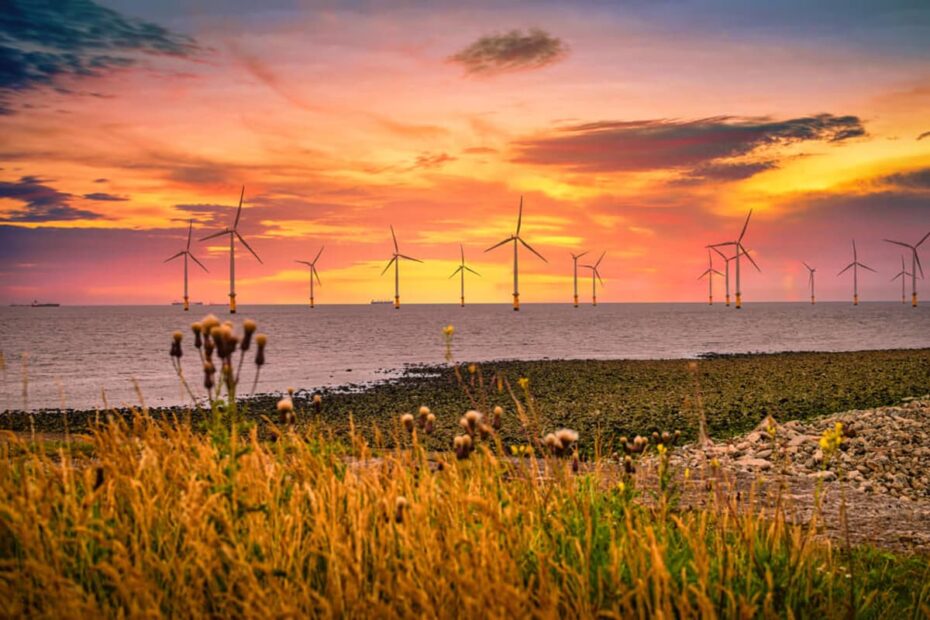
The UK government has awarded 8.4GW of contracts under its biggest single auction for offshore wind.
It claimed the auction will unlock around £22bn in private investment, supporting around 7,000 jobs.
Projects include Dogger Bank South off the coast of Yorkshire, Norfolk Vanguard off East Anglia, Berwick Bank in the North Sea and Awel Y Môr, the first Welsh project to win a contract in more than a decade.
Using the levelised cost of energy industry metric, the government said the fixed offshore wind in today’s auction was £90.91 per megawatt hour (MWh) on average, compared with 147 MWh to build and operate a new gas-fired power station.
Given the intermittency of renewables, gas will continue to be pivotal to delivering UK grid power. Natural gas, via LNG, is crucial for the UK’s electricity system, providing flexibility, stability, and energy security by quickly ramping up or down to balance the unpredictability of renewables.
Cutting industrial electricity prices in the UK remains an ongoing challenge. Costs are the highest in the G7 and 46% above the median for the 32 member states of the International Energy Agency.
The government claims the auction reduces the UK’s exposure to “volatile global fossil fuel markets” but it doesn’t solve the conundrum of producing clean electricity at scale, even if does go some way to restoring market confidence in offshore wind. At the previous auction round (numbered five), not a single offshore wind project was secured.
Energy Secretary Ed Miliband said it was a “monumental step” towards reaching clean power by 2030.
Neil McDermott, CEO at the Low Carbon Contracts Company (LCCC), said the results from this allocation round were a prime example of the Contracts for Difference mechanism’s greatest strengths – providing certainty for investors and supporting jobs.
Low-carbon and long-term energy storage
As the energy transition builds, and renewable energy grows in the mix, the question of how to store electricity most effectively for grid flexibility has been climbing the agenda in the UK and elsewhere.
Gas-fired power plants are the most common fast-response option of choice today, increasingly allied to lithium-ion batteries to manage short-duration balancing challenges.
But it is also understood that another piece in the puzzle is needed in the form of low-carbon long-duration energy storage. This means large stores of low- or zero-carbon energy that can be accessed and used from four to up to 20 hours at a time, and sometimes even longer.
One of the leading moves in this space is a cryogenic technology that delivers precisely such long-duration storage – the use of liquid air to deliver stored energy.
On an international stage, the first mover on this opportunity today is the UK company Highview Power. Its first commercial-scale plant is now taking shape, to be followed by four much larger plants by 2030, with two to be built in Scotland and two in England.
Each of the four larger planned UK facilities is a 2.5GWh plant and due to come onstream by 2030, but before that Highview will deliver the smaller project at Carrington near Manchester, in north-west England.
The plant encompasses compression, liquefaction, and storage of air, ready for regasification and being put through a steam turbine to make electricity.
The Carrington plant should be ready to switch on in the first quarter of 2026 and will serve as an important test-case for the new grid-balancing technology.