
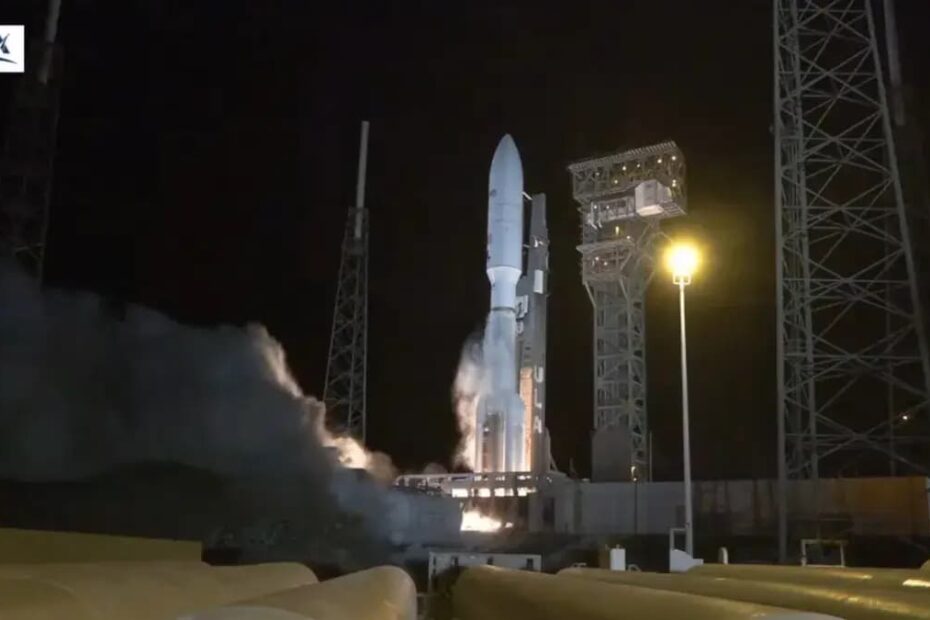
United Launch Alliance’s (ULA) Atlas V rocket has successfully lifted off, carrying another batch of satellites for Amazon’s Project Kuiper low Earth orbit broadband constellation. The launch relied on large volumes of cryogenic industrial gases.
In the final hours ahead of launch, around 66,000 gallons of liquid oxygen and liquid hydrogen were loaded into the Atlas V rocket and its Centaur upper stage at Cape Canaveral Space Force Station in Florida, US.
The fuelling operation was carried out over a tightly controlled 90-minute window, with propulsion console operators commanding pad systems from ULA’s Launch Control Center.
ULA is a US launch provider formed as a joint venture between Lockheed Martin Space and Boeing Defense, Space & Security.
The company confirmed on its official X account that the Atlas V flight carried “another batch of 27 satellites” for the Amazon LEO 4 mission, continuing the phased deployment of Amazon’s Kuiper constellation.
Amazon’s Project Kuiper is a low Earth orbit satellite programme designed to provide global broadband connectivity.
The initiative aims to deploy a constellation of more than 3,000 satellites to deliver high-speed, low-latency internet access, particularly to underserved and remote regions.
Cryogenic propellants are crucial. The rocket’s first stage uses liquid oxygen and RP-1 kerosene, while the Centaur upper stage is powered by liquid hydrogen and liquid oxygen.
Liquid hydrogen must be stored and transferred at around –253°C, placing stringent requirements on insulation, transfer systems, and timing to manage boil-off ahead of launch.
The use of cryogenic fuels allows for high propulsion efficiency and accurate orbital placement, while also highlighting the need for dependable cryogenic gas supply and launch-site infrastructure.
Space launch remains one of the most demanding end-uses for liquid oxygen and liquid hydrogen, with strict requirements around purity, delivery reliability, and handling.
Beyond launch, cryogenic gases are also increasingly being explored for in-space operations.
Companies such as Eta Space are developing cryogenic storage, transfer, and ground-support technologies aimed at enabling orbital refuelling and long-duration missions.
gasworld spoke with Eta Space CEO William Notardonato earlier this year. Read more here.